
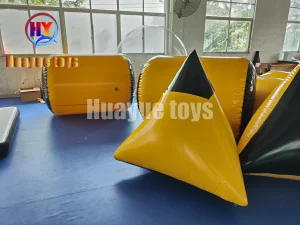
Marine Regatta & Demarcation
Engineered with welded 0.90mm to 1.20mm high-tenacity UV-treated PVC fabrics, reinforced internal baffle chambers, and multi-point stainless steel 316 D-ring anchor plates for Australian waters.
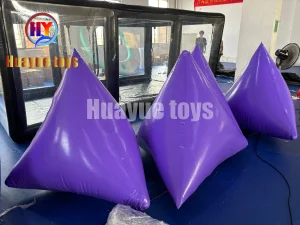
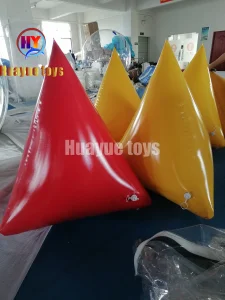
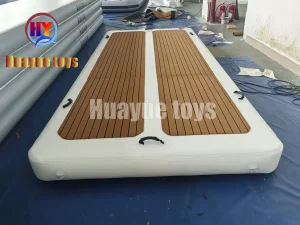
Australia encompasses one of the world's most demanding maritime footprints. Spanning tropical reef complexes across the Coral Sea to the violent high-energy swells of the Roaring Forties off the Tasmanian coastline, commercial marine operators, sailing clubs, and port authorities face extraordinary environmental pressures. Historically dominated by rigid, heavy rotationally molded polyethylene (PE) or steel mooring canisters, the Australian marker and buoy market is executing a rapid transition toward high-spec elastomeric inflatable systems.
The logistical burden of moving rigid navigation buoys across expansive distances—such as transporting equipment from Fremantle to the Pilbara iron ore export terminals or staging international yachting regattas across Sydney Harbour, Moreton Bay, and Port Phillip—incurs prohibitive freight overheads. Inflatable buoys manufactured from multi-ply 1,100 dtex to 1,670 dtex polyester-reinforced polyvinyl chloride (PVC) and thermoplastic polyurethane (TPU) collapse to less than 4% of their inflated volume, drastically curtailing transport mass and handling fuel burn.
The Australian marine recreational and commercial sector generates over $14.7 billion annually. From the high-profile Rolex Sydney Hobart Yacht Race to resource demarcation across BHP and Rio Tinto wet infrastructure corridors, key operational imperatives dictate buoyant assets:
Australia receives up to 15% higher solar ultraviolet irradiation than equivalent European latitudes. Buoys require UV absorbers matching AS 4174 weathering thresholds.
Warm, high-saline coastal conditions in Northern WA and Queensland accelerate plasticizer migration and micro-cracking in cheap polymers, demanding hot-air and high-frequency welded seams.
Commercial marine marker survival depends on seam shear strength, rip-stop tensile values, and ballast hydrodynamic stability when confronted with 40-knot coastal squalls and 3-meter sea chop.
Constructed with a dense 1000D/1300D polyester core yarn woven in an anti-tear panama structure, coated symmetrically with specialized PVC incorporating UV stabilizers, mildew inhibitors, and flame-retardant plasticizers. Tensile strength exceeds 3500N/5cm with puncture resistance designed to resist barnacle scrapes and boat impacts.
Unlike solvent-based manual adhesive joints that suffer catastrophic delamination when stored inside humid containers or hot boat lockers, our high-frequency dielectric and hot-air fusion welding fuses fabric coatings at the molecular level, creating a continuous hermetic bond with a failure threshold superior to the base material itself.
Equipped with submerged water-ballast pockets beneath the waterline. As sea state intensifies, the ballast chambers naturally self-fill with ambient seawater, lowering the buoy's center of gravity (CG) and providing self-righting restoring moments against gust-induced tipping without requiring dangerous steel ballast deadweights on deck.
| Performance Metric | Standard Commercial Grade | Huayue Heavy-Duty Marine Spec | Australian Operational Impact |
|---|---|---|---|
| Base Fabric Density | 500D - 840D Polyester | 1000D - 1300D High Tenacity Core | Withstands high-load towing and sharp boat rubbing in busy regattas. |
| Fabric Thickness | 0.50mm – 0.65mm | 0.90mm – 1.20mm Commercial PVC / TPU | Resists UV hardening, ozone breakdown, and puncture from dock debris. |
| UV Degradation Resistance | 200–300 UV Hours | 1,500+ UV Index Rated Hours (AS 4174 compliant) | Eliminates color bleaching and surface tackiness under intense Australian sunlight. |
| Seam Construction | Solvent Cold-Glueing | Automated High-Frequency Dielectric Fusion | Zero seam leakage under 0.25 bar operational air pressure and thermal expansion. |
| Mooring Hardware | Zinc or SS201 Metal Rings | Marine Grade 316 Stainless Steel D-Rings (4-Layer Reinforcement) | Immunity to pitting corrosion and crevice rust in warm salt-water conditions. |
From Olympic-class sailing events to remote Western Australian mining operations, inflatable buoy systems resolve complex environmental and logistics requirements.
Australia hosts elite offshore and closed-course racing regattas, including the Cruising Yacht Club of Australia (CYCA), Royal Brighton Yacht Club, and Hamilton Island Race Week. Traditional steel buoys require heavy cranes, barge tenders, and lead anchor chains that gouge sensitive marine beds. Our conical, cylindrical, and triangular racing marks feature high-visibility fluorescent yellow, blaze orange, and signal purple profiles that provide sharp visual identification through tactical polarized optics under intense glare.
Infrastructure initiatives across the Port of Brisbane, Port Hedland, and Darwin Harbour demand clear, rapidly adaptable waterway segregation. High-durability inflatable boundary markers mark dredging zones, submerged pipeline hazards, underwater blasting corridors, and temporary exclusion zones. Their pneumatic compressibility guarantees that any accidental low-speed strike by pilot boats or tug tenders incurs zero damage to hull structures or telemetry equipment.
Surf Life Saving Australia (SLSA) branches across New South Wales, Queensland, and Western Australia manage demanding competitive circuits through high-energy surf breaks. Rigid marks are dangerous hazard zones for swimmers and board paddlers in heavy shore breaks. Our soft-deceleration inflatable ocean markers absorb heavy breaker loads without capsizing, ensuring athlete safety while maintaining GPS station under anchor tension.
Tasmanian salmon farming leases, Spencer Gulf finfish cages, and Broome pearl leases require thousands of surface demarcation points to designate lease boundaries, subsurface longline grid anchors, and net arrays. Customized multi-chamber inflatable buoys offer cost-effective modular reserves that resist encrusting biofouling, can be jet-washed effortlessly, and provide failsafe buoyancy through partitioned dual-bladder designs.
Across inland water networks such as the Snowy Hydro scheme, Murray-Darling river systems, and Lake Eildon, water management authorities utilize inflatable barrier buoys to cordon off hazardous intake spillways, shallow submerged shoals, and protected water catchment areas. These buoys withstand dramatic seasonal water level fluctuations without requiring heavy crane barges for relocation.
With Australia's booming superyacht charter operations along the Whitsundays and Great Barrier Reef, yacht captains require compactable water sports perimeter buoys, tender mooring pick-ups, and inflatable floating swim pools. Rapid deflatability allows yacht crews to pack away complete multi-hectare swimming zones and jet-ski slalom arenas into tender garages within minutes.
Australian marine hardware procurement has traditionally been burdened by layered distribution models. Local commercial chandleries and intermediaries regularly add 60% to 150% markups onto imported inflatable assets, often stocking generic catalogue SKUs that fail to incorporate vital custom specifications such as reinforced mooring harness webs, specific IALA maritime color codes, or custom club sponsor screen-printing.
By engaging directly with Huayue Inflatable's integrated 6,250 m² Guangzhou manufacturing complex, Australian commercial buyers unlock direct factory engineering. Our engineering department develops comprehensive 3D parametric models for your buoys within 24 hours, integrating your exact mooring load calculations, anchoring eye requirements, and radar-reflective internal sleeves before fabric cutting commences.
Strategic Supply Chain Efficiency: Direct sea-freight links from Guangzhou to Sydney, Melbourne, Brisbane, and Fremantle reduce lead times to 14–21 sailing days, supported by complete AS/NZS compliance documentation and factory pre-shipment 48-hour pressure-drop diagnostic certifications.
Our Guangzhou specialized manufacturing facility integrates automated German CAD cutting benches, robotic dielectric welders, and stringent pressure-testing protocols.
Operating buoyant marine assets across Australian federal, state, and coastal waters requires unconditional compliance with statutory marine safety mandates.
Australia adheres strictly to IALA Region A standards. Our marker buoys conform precisely to required chromatic color coordinates for Port Lateral (Red, can-shaped topmarks), Starboard Lateral (Green, conical topmarks), Cardinal Marks (Black/Yellow band sequences), and Special Marks (High-chroma Yellow), ensuring complete navigational safety and regulatory alignment with state maritime authorities.
For commercial water park barriers, floating sports tracks, and inflatable safety perimeters, products are engineered to comply with AS 3533.4.1 (Amusement Rides and Devices - Inflatables) and relevant marine flotation safety ISO standards. We eliminate entrapment zones, optimize tether release mechanisms, and provide burst pressure margins exceeding 3x working pressure.
Protecting sensitive coral ecosystems, sea turtle feeding beds, and marine sanctuaries is a legal and moral requirement under the Environment Protection and Biodiversity Conservation Act (EPBC Act). Huayue materials are certified free of heavy metals (lead, cadmium, barium), low-VOC formulated, and compliant with EU REACH standards to ensure no chemical leaching occurs in sensitive marine zones.
The convergence of pneumatic marine engineering, renewable micro-generation, and satellite telemetry is reshaping maritime asset intelligence.
Deployment of high-frequency welded 1.20mm TPU and aliphatic polyurethane coatings that offer complete hydrolytic stability and zero plasticizer bleed in warm tropical sea basins.
Flexible, vulcanized thin-film photovoltaic (PV) solar panels laminated directly to buoy crowns, driving low-power LoRaWAN transmitters and autonomous GPS drift-alert sensors.
Integration of twin brushless electric thrusters and RTK-GPS dynamic positioning (DP) algorithms, allowing regatta buoys to hold station automatically without laying sea-bed anchors.
Fully recyclable, closed-loop bio-polyurethanes derived from plant feedstock, achieving a near-zero carbon manufacturing footprint with identical marine tensile endurance.
Comprehensive technical guidance on inflation mechanics, mooring dynamics, UV preservation, and custom manufacturing protocols.
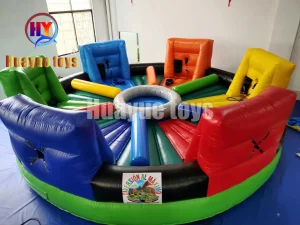
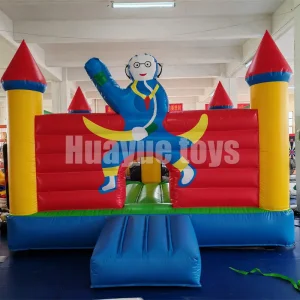
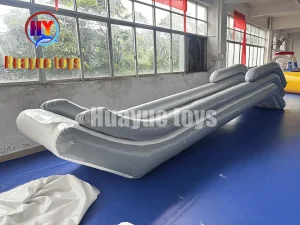
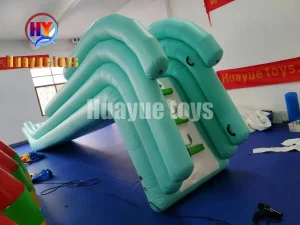
Explore our extended range of heavy-gauge inflatable attractions, marine slides, event games, and modular platforms built for Australian resort and rental fleets.
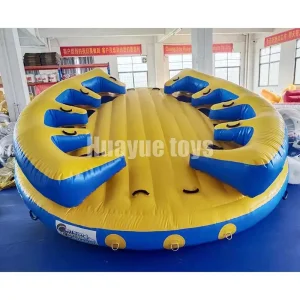
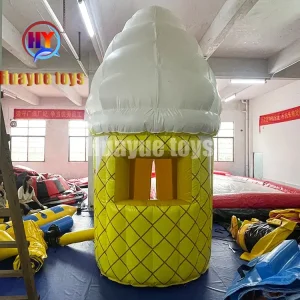
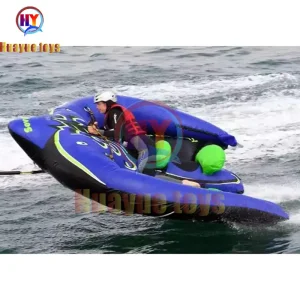
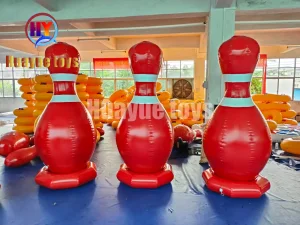
Connect directly with Huayue's marine engineering workshop. From custom IALA regatta marker buoys to complete modular floating docks and commercial water parks, we deliver 3D approval renderings within 24 hours and factory-direct sea freight to all major Australian ports.