Commercial-grade airtight welded platforms built from UV-stabilised 0.9mm PVC tarpaulin for offshore racing, coastal zoning, and commercial port operations across the UK.
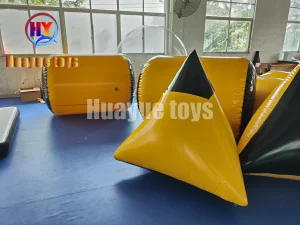
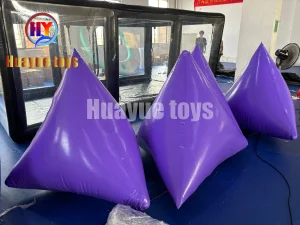
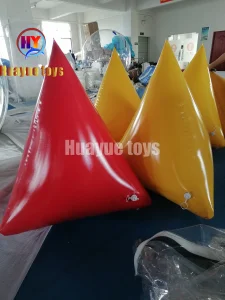
The United Kingdom possesses over 11,000 miles of rugged coastline subjected to intense semi-diurnal tides, high wind shear, and significant salinity fluctuations. From historic regattas in the Solent to offshore energy perimeters around the Dogger Bank and North Sea wind installations, structural reliance on durable inflatable buoys has evolved from seasonal recreation into an indispensable operational safety requirement.
Traditional rigid steel or rotomoulded polyethylene buoys present extreme logistical friction—requiring dedicated crane vessels, substantial deck real estate, and costly harbor berth time. Modern marine civil engineers and UK sailing associations increasingly implement multi-chamber inflatable marker systems engineered with heavy-gauge PVC and high-tenacity polyester scrim, drastically lowering deployment logistics while maintaining hydro-dynamic upright stability.
Globally, the marine marker and pneumatic barrier sector is undergoing rapid vertical integration. European and North American project developers demand stringent compliance with ISO 9001 and CE/EN safety benchmarks, which necessitates direct partnerships with specialized Asian manufacturing workshops capable of advanced hot-air thermal seam sealing and high-frequency fusion welding.
Our Baiyun-based 6,250 m² manufacturing plant functions as the engineering heart for international maritime distributors. By combining European-imported CNC cutting plots, computerised high-frequency ultrasonic welders, and dual-layer ballistic base reinforcements, we bridge the gap between competitive industrial pricing and the zero-failure tolerance demanded by Western nautical institutes.
Every production batch undergoes 48-hour continuous hydro-static pressure testing, salt spray resistance verification (ASTM B117), and cyclic load analysis for stainless steel D-ring anchor plates.
Engineered to resolve real-world deployment challenges in estuaries, open lochs, open bays, and coastal civil engineering zones.
Triangular and cylindrical inflatable buoys featuring fluorescent high-visibility pigments, integrated radar-reflective inner foils, and quick-deflate valves for swift tactical course shifts across shifting tidal rips in the Solent.
Extreme-weather boundary markers designed for remote salmon farming facilities across the Highlands and Hebrides, featuring reinforced marine-grade 316 stainless-steel anchor bridles and bio-fouling-resistant PVC skins.
Temporary safety perimeters and cable-laying hazard identification buoys deployed in the North Sea. High visual cross-section and anti-abrasion bumper strips safeguard service vessels during hazardous operations.
High-contrast, easy-to-spot boundary markers and swim-lane turn buoys for nationwide events across Lake Windermere, Rutland Water, and municipal canals, meeting strict Royal Yachting Association safety criteria.
Bridging polymer science, self-sustaining renewable telemetry, and IoT tracking for modern marine asset management.
Transitioning from traditional plasticizers to fully recyclable thermoplastic polyurethanes (TPU) exhibiting extreme tensile shear, superior puncture resistance, and net-zero environmental leaching.
Self-adjusting internal water-ballast cavities that optimize center-of-gravity dynamically in response to real-time tidal shear, preventing overturning in Beaufort Scale 8 gales.
Integration of flexible thin-film photovoltaic cells feeding low-power AIS (Automatic Identification System) transponders and LoRaWAN position beacons directly on mark caps.
Pneumatic bladder elastomer matrices formulated with self-healing polymers that seal punctures under 3mm automatically upon contact with pressurized internal air and ambient moisture.
End-to-end industrial execution from bespoke CAD modeling to sea-freight documentation for European buyers.
Zero surprises upon delivery. Before a single bolt or PVC panel is cut, our structural engineering team delivers high-fidelity 3D renderings complete with hydro-static calculations, anchor load vectors, and customized club branding schemes.
Unlike inexpensive cold-glued inflatables that fail under summer sun exposure or tidal pressure, our manufacturing lines employ automated hot-air welding equipment, melting overlapping PVC strata into a permanent, homogenous leak-proof joint.
We provide full compliance dossiers for UKCA and CE testing, supply electrical high-speed inflation blowers compatible with UK 230V / 50Hz BS 1363 sockets, and manage DDP container or air shipments direct to Southampton, Felixstowe, or London Gateway.
Essential engineering and procurement answers for maritime project coordinators and overseas wholesale buyers.
Inflatable buoys drastically slash logistical overhead. A regatta organization or coastal operations squad can transport 20 deflated heavy-duty cylindrical buoys in the back of a standard commercial van, whereas rigid buoys require flatbed trucks, cranes, and significant storage space. Once deployed and properly ballasted with internal water bladders or chain arrays, inflatable markers provide comparable upright verticality with zero risk of catastrophic hull damage to colliding sailing vessels.
We utilize commercial-grade, multi-ply PVC tarpaulin with an internal 1000D x 1000D high-tenacity woven polyester base fabric, coated on both surfaces with UV-inhibited, hydrolytically stable polyvinyl chloride. For specialized arctic or harsh industrial environments, we fabricate using heavy-duty Polyurethane (TPU), which maintains flexible elasticity down to -30°C without seam brittleness or micro-cracking.
Our inflatable cylindrical and conical buoys are engineered with an integrated submerged ballast compartment located beneath the primary flotation air chamber. This chamber can be rapidly flooded with seawater on-site, lowering the center of gravity and stabilizing the buoy against wind tilt and 4+ knot current drag. Additionally, multi-point 316 stainless-steel D-ring bridles distribute mooring anchor load evenly across reinforced PVC mounting pads.
Because we operate our own 6,250 m² workshop with computerized layout tables, our MOQ starts as low as 1 to 5 units for bespoke custom prototypes, and 20+ units for wholesale container batches. Full 3D CAD approval is completed within 48 hours, with standard manufacturing completed in 10-15 business days followed by express sea or air freight to UK regional ports.
Yes. We feature high-definition digital UV printing with protective scratch-resistant overlaminates to guarantee that club logos and sponsor graphics do not peel under salt-spray abrasion. We also weld custom mounting brackets onto the apex to seat self-contained solar-powered marine LED marker lights (IALA compliant) and embed radar-reflective mesh inside the sealed airtight bladder.
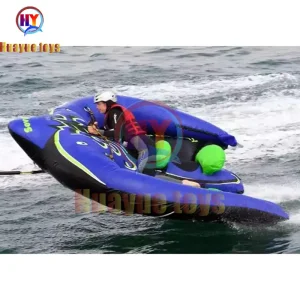
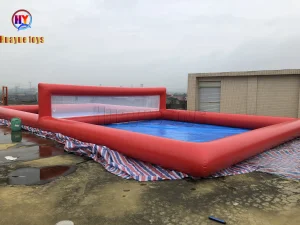
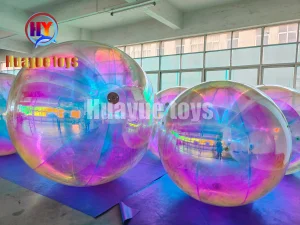
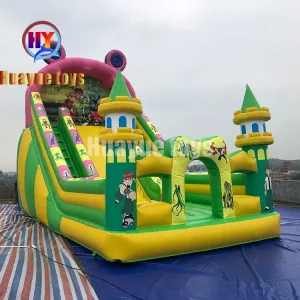
Explore our extended lineup of heavy-duty inflatables engineered for UK and European yacht owners, leisure operators, sports events, and corporate attractions.
Connect with our structural engineering team today to review blueprints, get customized 3D buoyancy renderings, and access direct export pricing.
Send Inquiry Now