Direct factory manufacturing configured to withstand northern German maritime conditions, inland lakes, and high-frequency leisure commercial facilities.
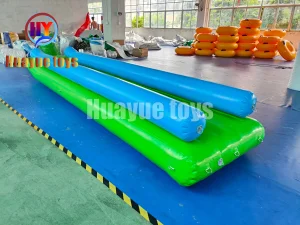
In-depth industrial analysis on environmental regulations, seasonal demands, water quality standards, and structural engineering compliance across German waterways.
Operating commercial water leisure installations in the Federal Republic of Germany (Bundesrepublik Deutschland) requires stringent adherence to both federal environmental protections and European structural safety codes. Germany’s comprehensive regulatory framework is governed by the Wasserhaushaltsgesetz (WHG) (Federal Water Act), which prohibits installations from leeching hazardous chemicals, microplastics, or plasticizers into inland aquifers, lakes (Badeseen), or coastal reserves.
Every commercial floating dock, modular floating swimming pool, or offshore inflatable slide must satisfy the engineering metrics established by DIN EN ISO 25649 (Floating leisure articles for use on and in water) and DIN EN 15649. These criteria evaluate tensile tear resistance, buoyant stability under irregular human dynamic loads, high-grade anti-submersion baffling, and puncture resistance. Furthermore, German regional state authorities (Wasser- und Schifffahrtsämter - WSA) enforce rigid anchoring parameters to safeguard benthic ecosystems, prohibiting traditional toxic concrete sinkers in favor of ecological helical screw moorings and dynamic tethering lines.
Central Europe continues to experience record-breaking summer temperatures, leading to an unprecedented surge in domestic tourism across German lake districts such as the Mecklenburg Lake Plateau (Mecklenburgische Seenplatte), Lake Constance (Bodensee), Chiemsee, and the Lusatian Lake District (Lausitzer Seenland). Commercial resort operators, public lidos (Freibäder and Strandbäder), and regional water tourism enterprises are rapidly pivoting away from permanent concrete or rigid timber docks. Traditional rigid docks face drawn-out municipal permitting processes, environmental pushback, and vulnerability to cyclical water table fluctuations.
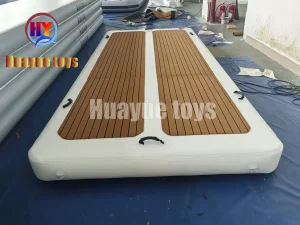
In contrast, drop-stitch heavy-duty PVC commercial inflatable floating platforms and modular docks present an eco-neutral, fully retrievable solution. Because these systems are non-permanent structures, approval cycles with municipal building inspection offices (Bauämter) and environmental authorities are significantly compressed. When the tourist season concludes in late September, operators can deflate, wash, dry, and store complete dock and pool installations in compact warehousing, safeguarding assets against winter freeze-thaw cycles and severe river ice flows along the Elbe, Rhine, and Danube waterways.
Bridging large-scale industrial output with German precision engineering, specialized material chemistry, and localized logistical protocols.
Global inflatable manufacturing frequently relies on standard commercial PVC formulations. However, for German distribution, all fabrics must pass stringent REACH Annex XVII chemical restrictions. Our custom formulations eliminate banned phthalates and volatile organotins, guaranteeing water safety across public freshwater reservoirs and municipal recreational zones.
While low-cost alternatives depend on cold solvent cementing—which rapidly deteriorates under fluctuating Central European weather—our manufacturing process integrates European high-frequency hot-air welders. This fuses 1100D/0.9mm PVC membranes at the molecular level, preventing catastrophic seam decompression during high-humidity summers.
Every floating dock, pool enclosure, and mega-yacht slide is built with pre-engineered load-distribution D-rings, redundant dual-chamber air valves, and anti-entrapment dimensions compliant with TÜV safety inspections. This significantly reduces on-site certification time for German operators seeking operational commercial permits.
Engineered to resolve real-world logistical, structural, and seasonal challenges across diversified maritime and inland hospitality sectors.
Deployable yacht slides and non-slip marine floating dock extensions designed for mega-yachts and luxury charter vessels anchored along Warnemünde, Rügen, and Kiel. High UV stabilizers and hyper-saline corrosion-proof 316 stainless-steel D-rings prevent marine degradation in harsh open water conditions.
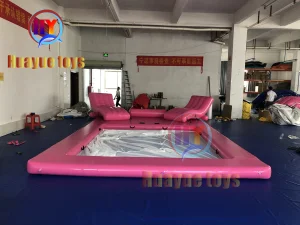
Public lidos in Bavaria, Baden-Württemberg, and North Rhine-Westphalia requiring jellyfish-free, sediment-free, enclosed swimming pools. Modular drop-stitch pool walls create safe open-water swim lanes and protected wading zones for children without heavy infrastructure permits.
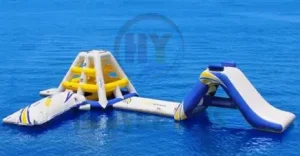
High-throughput floating pyramids, balance beams, and climbing towers installed adjacent to cable wakeboard centers (Wasserski-Anlagen). Built with double-layer reinforced friction pads to withstand thousands of visitor footfalls weekly while meeting strict German patron safety insurance standards.
Anticipating next-generation material science, intelligent pressure sensing, and circular economy circularity for the European market.
Under midday summer sun in southern Germany, air expansion inside inflatable chambers can risk overpressurization. Our next-generation modular docks integrate automated internal pressure relief valves combined with Bluetooth/LoRaWAN IoT sensors, transmitting barometric metrics directly to beach managers’ mobile dashboards.
In response to evolving German environmental mandates for closed-loop lifecycle products, we are introducing commercial-grade Thermoplastic Polyurethane (TPU) options. TPU provides 30% weight reduction over heavy PVC while offering total recyclability, lower cold-temperature cracking, and superior abrasion resistance.
Advancements in double-wall drop-stitch fabrics (DWF) allow our inflatable docks to reach working pressures up to 15–20 PSI. This delivers a surface rigidity nearly indistinguishable from solid hardwoods or composite platforms, permitting heavy loads including golf carts, maintenance machinery, and scuba charging stations.
Direct technical feedback covering regulatory compliance, electrical compatibility, logistical freight, and field operational procedures.
Our inflatable structures utilize premium high-density PVC and TPU fabrics certified free of prohibited substances under EU REACH Regulation (EC No 1907/2006). They do not leach heavy metals, phthalates, or toxic stabilizers into freshwater reserves or marine ecosystems, ensuring rapid permit approval from local German water authorities.
Yes. All continuous and sealed air inflator/deflator pumps supplied with our commercial units feature CE, GS, and VDE electrical compliance. They are configured for standard 220-240V, 50Hz single-phase operation and fitted with standard European CEE 7/7 Schuko plugs or specialized industrial marine locking plugs upon request.
For custom OEM orders, 3D visual engineering and production take 15–25 business days. Sea freight shipping to major German ports (Port of Hamburg, Bremerhaven, or Wilhelmshaven) typically requires 28–35 days. We provide comprehensive import documentation including Commercial Invoices, Packing Lists, Certificates of Origin, and Harmonized System (HS) codes for effortless Zoll customs processing.
Our marine fabrics incorporate cold-crack resistant plasticizers certified stable down to -30°C. At the end of the season, the modules should be rinsed with fresh water, thoroughly dried, deflated, and folded. Storing them in provided PVC transport valises inside a ventilated depot prevents vermin intrusion and frost cracking throughout Bavarian or Baltic winters.
Explore our extended series of wholesale marine platforms, leisure yacht slides, and custom floating pools engineered to highest international standards.
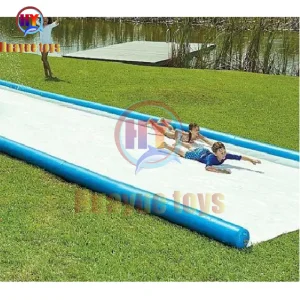
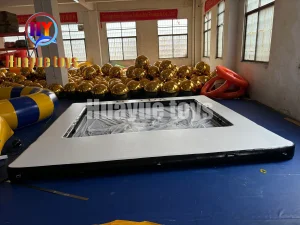
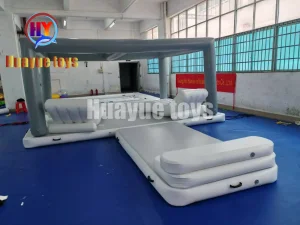
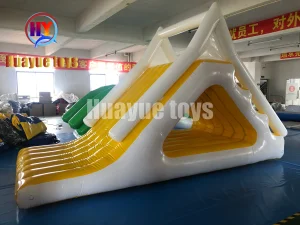
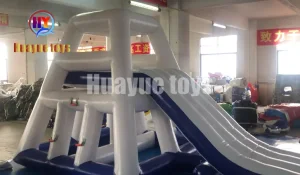
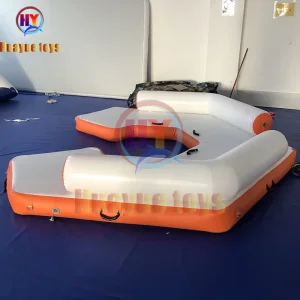
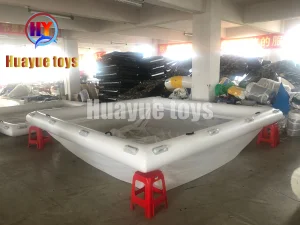
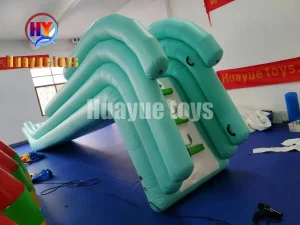
Direct factory prices, certified marine engineering, custom 3D design approval within 48 hours, and door-to-door DDP logistics into Germany, Austria, and Switzerland.
Send Inquiry Now