Manufactured using calibrated 0.9mm to 1.2mm high-tensile composite PVC tarpaulin with dielectric high-frequency heat-welded seams.
From dynamic crane load testing and civil cofferdams to commercial floating recreational architecture, flexible elastomeric membrane technology is transforming water containment and ballast logistics.
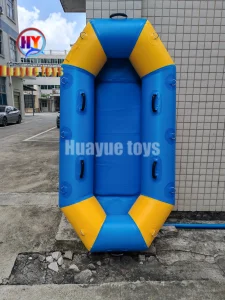
Modern inflatable water bags and commercial inflatables must withstand extreme dynamic stresses. As leading inflatable water bags manufacturers, our production protocol leverages dense, cross-laminated polyvinyl chloride (PVC) and thermoplastic polyurethane (TPU) reinforced with high-tenacity 1,000D to 1,500D polyester filaments. The polymer matrix is integrated with specialized UV stabilizers, anti-fungal additives, and chemical plasticizers to resist prolonged degradation under saltwater exposure, ozone, and severe thermodynamic cycling.
Unlike standard recreational inflatables, commercial water weight bags and liquid retaining bladder systems operate under intense hydraulic head pressure. Utilizing imported hot-air welding equipment and high-frequency dielectric radio wave fusion, our factory achieves hermetically sealed, homogenous molecular seams. Our joint efficiency routinely meets or exceeds 95% of parent substrate tensile strength, eliminating mechanical peel vulnerability even under cyclic loading exceeding 35 kPa working pressures.
For international buyers sourcing from a wholesale inflatable water bags manufacturer, logistical volume optimization is paramount. Collapsible elastomer systems reduce transport cube requirements by up to 94% compared to rigid steel weights or rigid plastic polyethylene tanks. Our Guangzhou hub, positioned within minutes of global logistics corridors, streamlines multimodal sea-air supply chains for resorts, maritime operations, and structural test facilities across North America, Europe, Oceania, and the GCC.
Evaluating the mechanical intersection between temporary hydro-containment, kinetic shock absorption, and marine water ballast architecture.
Water-filled proof load bags represent the gold standard for maritime crane certification, davits, offshore platforms, and shipboard hoist systems. As an OEM manufacturer, our production floor crafts teardrop and cylindrical water weight bags rated from 1 metric ton to 50 metric tons. Integrated with heavy-duty polyester sling harnesses (conforming to EN 1492-1 safety factors of 6:1 or 7:1) and high-flow marine-grade ball valves, these elastomeric systems eliminate the hazardous handling of solid steel ballast blocks while facilitating continuous, controlled test filling.
Civil engineering contractors utilize our dual-tube and multi-chamber water barrier bags for dewatering construction sites, stream diversions, and municipal flood mitigation. When filled with on-site water, the internal hydraulic mass creates an unbroken friction seal against sand, mud, and concrete substrates. The flexibility of 0.9mm to 1.5mm high-grade PVC tarpaulin allows the barrier to adapt seamlessly to uneven terrain contours without structural cracking, offering an environmentally non-invasive alternative to sandbags.
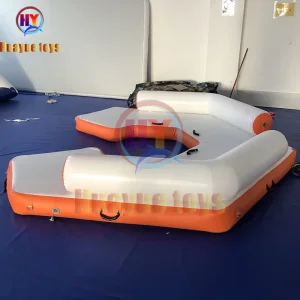
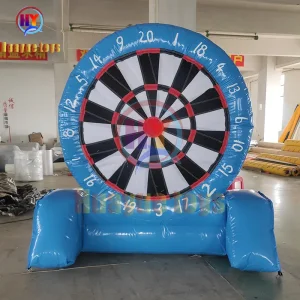
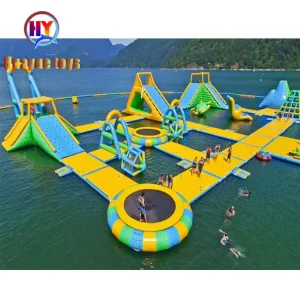
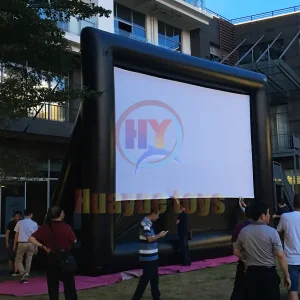
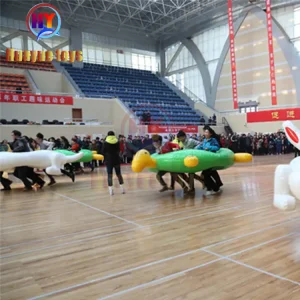
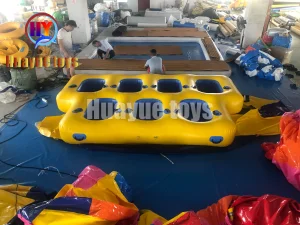
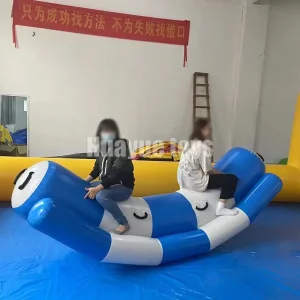
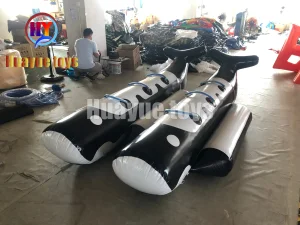
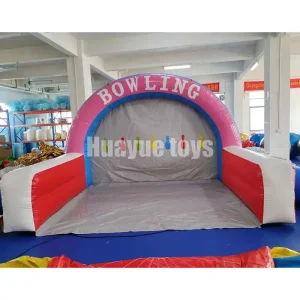
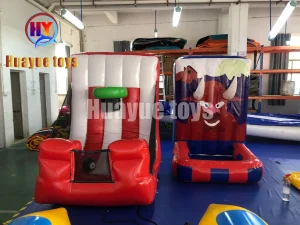
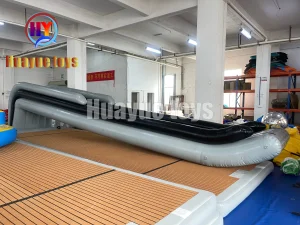
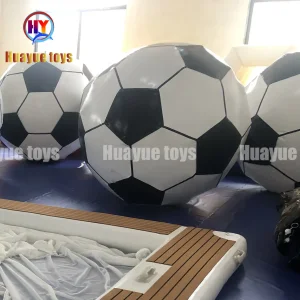
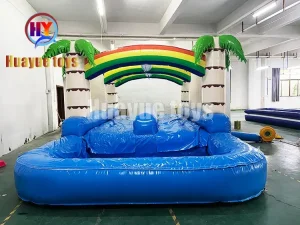
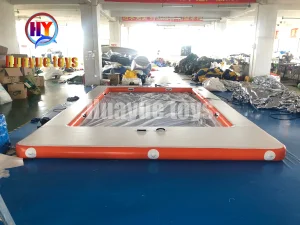
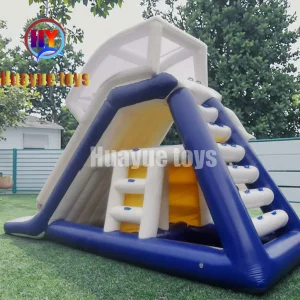
Expanding from static fluid containment to dynamic aquatic leisure, our Guangzhou workshop engineers floating obstacle systems, towable crafts, and high-impact water parks. By balancing buoyancy calculations, hydrodynamic drag reduction, and high-energy impact dampening, our modular inflatables withstand extreme environmental conditions—including intense coastal UV, continuous saltwater immersion, and high bather throughput—ensuring unmatched durability and passenger safety.
| Technical Parameter | Commercial Inflatable Water Bags | Floating Aquatic Parks & Docks | Land-Based Commercial Inflatables |
|---|---|---|---|
| Substrate Material | Heavy-Duty High-Tensile PVC / TPU | Commercial-Grade Marine PVC (0.9 mm) | Commercial PVC Tarpaulin (0.55 mm) |
| Base Fabric Density | 1,000D – 1,500D Polyester Core (30×30) | 1,100 dTex Panama Weave | 1,000 dTex Plain Weave |
| Tensile Strength (Warp/Weft) | ≥ 3,800 / 3,400 N / 50mm (ISO 1421) | ≥ 3,200 / 2,800 N / 50mm | ≥ 2,600 / 2,200 N / 50mm |
| Seaming Technology | Automated HF Dielectric & Thermal Fusion | High-Frequency Dual-Track Thermal Welding | Reinforced Quadruple Lock-Stitch Seams |
| Temperature Resistance | -30°C to +70°C (-22°F to 158°F) | -20°C to +65°C (-4°F to 149°F) | -15°C to +60°C (5°F to 140°F) |
| International Compliance | ISO 9001, LEEA 051 Guidance, CE Marking | EN ISO 25649 (Class A-D), CE / REACH | EN 14960:2019, ASTM F770 Standards |
Ensuring frictionless international clearance, institutional safety acceptance, and multi-jurisdictional conformity across major trade regions.
European resort operators and rental fleets demand uncompromising adhesion to the EN ISO 25649 standard for floating leisure articles and EN 14960 for inflatable play equipment. Our design engineering integrates anti-entanglement anchor rings, calibrated entrapment gaps (guarding head, neck, and finger vulnerabilities), and flame retardancy certified to DIN 4102-B1 and NFPA 701 specifications. In addition, all materials are verified non-toxic under REACH regulation (EC No 1907/2006).
For distributors across the United States and Canada, our products adhere to ASTM F770-18 for operational practices in amusement devices and OSHA requirements for ballast and temporary fluid works. Ballast bladders and water load bags incorporate stamped Proof Load Certificates and certified anchor harness systems. Electrical inflation units are configured with UL/cUL-recognized electric motor blowers operating at 110V/60Hz with appropriate NEMA weather-rated plugs.
Operating in the Middle East, Southeast Asia, and Caribbean zones requires superior thermodynamic stabilization. Under continuous ambient temperatures exceeding 45°C (113°F) and extreme solar ultraviolet radiation, inferior plastics suffer plasticizer migration and tensile brittleness. As an expert inflatable water bags manufacturer, we incorporate broad-spectrum UV absorbers and chemical anti-yellowing agents, guaranteeing dimensional stability and color fastness exceeding 5 years under equatorial marine exposure.
From algorithmic CAD stress modeling to multi-point hydrostatic holding tests, every unit follows a disciplined engineering protocol in our 6,250 m² Guangzhou plant.
Finite element analysis (FEA) models fluid weight displacement, internal hydrostatic pressure, and anchoring tension loads to confirm material thickness prior to raw material cutting.
Automated flatbed laser and knife cutters translate digital vector geometry onto polymer sheets with sub-millimeter tolerances, eliminating manual cutting discrepancies.
High-frequency radio waves and European-imported hot-air welders melt polymer chains together under hydraulic clamp pressure, creating a molecularly fused, leakproof joint.
Units undergo continuous 24- to 48-hour pressure-decay testing. Digital barometric transducers verify that no micro-perforations or seam fissures exist across all air and water cells.
Vacuum-compressed, reinforced PVC tarpaulin travel envelopes and palletized crating protect finished systems during international maritime and multimodal container shipping.
Engineered for high-traffic rental operators, commercial resorts, and maritime projects requiring extreme tear resistance and structural reliability.
Critical considerations on hydrostatic parameters, material polymer selection, load factors, and global logistics workflows.
Under disciplined operational care, proper drying protocols before off-season storage, and adherence to pressure thresholds, our commercial 0.9mm PVC tarpaulin systems yield an average service lifespan of 5 to 8 years in high-turnover rental and industrial load-testing environments. In enclosed or fresh-water resort applications, this lifespan frequently extends beyond 10 years without structural seam degradation.
According to Gay-Lussac's Law, the pressure of a gas increases proportionally with temperature. Direct summer sunlight can cause interior chamber air pressure to escalate by up to 25% to 35% within 3 hours. To prevent catastrophic over-pressurization, all Huayue sealed inflatable modules, water barriers, and platform components feature automatic overpressure relief safety valves factory-calibrated to discharge when pressure reaches 110% of standard operating values.
Yes. As a full-scope inflatable water bags manufacturer, our design division offers end-to-end bespoke modeling. Whether your project necessitates a 20-ton specialized industrial crane proof-testing bladder with certified rigging, an anti-jellyfish floating sea pool tailored to yacht transom dimensions, or custom-themed municipal waterpark layouts, our engineers build 3D CAD prototypes for approval before cutting begins.
Every commercial production run undergoes a mandatory 24- to 48-hour pressure stability test in our Guangzhou workshop, monitored via electronic pressure logging. Buyers receive complete digital QA dossiers, including tensile test data sheets, anti-mold and fire-retardant laboratory certificates (NFPA 701, DIN 4102-B1), EN 14960 / CE conformity documentation, and serialized inspection certificates for customs and insurance validation.
Anchoring security is the cornerstone of aquatic safety. Our marine anchor plates utilize marine-grade 316 stainless steel D-rings. These are encapsulated within multi-layered circular PVC reinforcement patches (minimum 5 layers) cross-welded via high-frequency heat fusion. Each anchor point on our commercial systems is rated to withstand tensile pull forces ranging from 1,200 kg to 2,500 kg without delaminating.
Standard OEM/ODM orders require 15 to 25 business days for fabrication, depending on system complexity and total volume. Situated in Guangzhou, Baiyun District—under 15 minutes from Guangzhou Baiyun International Airport (CAN) and near Nansha / Shenzhen ocean ports—we can deliver air-freight samples within 5-7 days and full 20ft/40ft maritime container dispatch within 18-30 days to major global seaports.
Anticipating structural, environmental, and digital monitoring transformations in industrial flexible water bags and commercial floating infrastructure.
While PVC tarpaulin remains the cost-effective industrial workhorse, ecological standards are driving greater adoption of bio-compatible TPU membranes. TPU delivers 3x the abrasion resistance of PVC, superior cold-crack resistance down to -40°C, and complete freedom from phthalate plasticizers. We are pioneering lightweight, high-modulus TPU bladder solutions for potable water deployment and sensitive marine conservation zones.
The next generation of industrial water weight bags and critical flood control barriers integrates embedded pressure, fluid-level, and thermal IoT sensors. These low-power digital transducers transmit continuous hydrostatic load data via LoRaWAN or Bluetooth mesh networks to field engineers' tablets, providing automated alert triggers for unexpected pressure loss or overload states during critical load tests.
In response to international carbon footprint reduction frameworks, our facility is actively engineering take-back recycling streams. By shredding decommissioned PVC membranes into micro-pellets for industrial sub-flooring, footings, and geomembrane liners, we minimize post-industrial landfill disposal while meeting global ESG mandates for commercial clients worldwide.
Bypass intermediary markups. Receive direct-from-factory pricing, customized 3D CAD modeling within 24 hours, and guaranteed compliance from Guangzhou's premier commercial inflatable production facility.