Direct-from-factory modular water slides, floating parks, towables, and high-tensile installations ready for commercial deployment.
Strategic market analysis, macroeconomic growth drivers, and evolving regulatory benchmarks shaping the future of global aquatic leisure infrastructures.
The global commercial water slide and aquatic entertainment park sector has undergone a profound structural shift over the past half-decade. Historically dominated by rigid, capital-intensive fiberglass construction requiring multi-million-dollar civil groundwork and permanent environmental alteration, the modern market has aggressively adopted high-tensile, modular inflatable water slides and floating sports systems. According to recent international tourism and recreation research, modular water parks and deck-mounted marine yacht slides represent the fastest-growing segment in commercial waterfront entertainment, registering a compound annual growth rate (CAGR) surpassing 8.4% through 2030.
This expansion is catalyzed by three fundamental vectors: capital flexibility, speed of monetization, and ecological compliance. Commercial resorts, private beach concessions, municipal water authorities, and luxury charter fleets require modular solutions that can be commissioned in days rather than months, dismantled during off-season winterization to eliminate permanent real estate depreciation, and configured with dynamic spatial geometry that preserves sensitive marine benthos and shoreline topographies.
Commercial inflatable water slide architectures reduce initial facility expenditure by up to 72% relative to stationary concrete and fiberglass slides, accelerating operational break-even points to within 1.5 seasonal cycles.
Floating installations eliminate maritime civil engineering permits by employing low-impact eco-anchoring grids that respect coral barriers and benthic organisms while fully complying with international blue-flag directives.
Patented interlocking connection sleeves allow operators to alter water climbing slides, drop chutes, and obstacle tracks annually, renewing patron novelty without incurring replacement capital costs.
Rising global charter vessel metrics demand bespoke superyacht slides with custom freeboard deck geometries, non-abrasive hull-contact liners, and rapid deployment air-manifold charging systems.
A complete engineering checklist for hospitality groups, municipal developers, and charter enterprises auditing commercial water slide suppliers.
Selecting a certified commercial water slide supplier requires rigorous technical evaluation beyond cosmetic catalog photography. B2B procurement teams must assess structural seam methodology, hydrostatic pressure degradation thresholds, and composite polymeric formulations. When evaluating factory bids, our manufacturing methodology benchmarks the following critical structural variables:
Turnkey operational methodologies configured for distinct aquatic environments, user density metrics, and shoreline safety protocols.
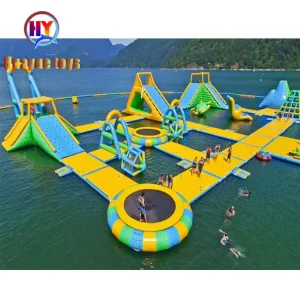
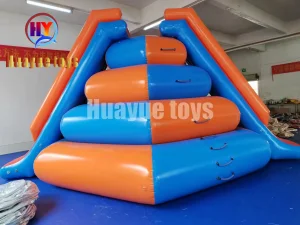
Engineered for high-throughput family hospitality venues. Integrates low-angle ascending slides, safe-entry climbing towers, balance tracks, and floating perimeter docks with dedicated lifeguard observation sightlines.
Reinforced for dynamic tidal environments. Features heavy-duty hydrodynamic wave-dissipation pontoons, bottom-scour elastic mooring tethers, and high-freeboard water climbing slides capable of operating under 1.2m swell conditions.
Tailored CAD design contoured to the precise shear and tumblehome curves of private vessel transoms and bridge decks. Includes drop-stitch anti-abrasion hull protectors and dual-chamber quick-evacuation valves.
Compact modular water slides designed for stationary concrete pool perimeters. Utilizes weighted non-slip ballasting outriggers and continuous low-noise air inflation units meeting strict metropolitan noise ordinances.
Eliminating liability risks for global operators via exhaustive international compliance verification and on-site technical support protocols.
Every commercial floating water slide module complies strictly with European safety directives for floating leisure articles, validating buoyancy volumes, entrapment prevention geometries, and impact decel zones.
Land-based bounce slides and obstacle structures undergo third-party laboratory verification for tear elongation, flammability thresholds (NFPA 701), and structural anchor load transfer factors.
All accompanying inflation blowers and high-output continuous pressure pumps are tailored to destination grid voltages (110V/60Hz or 220–240V/50Hz) with CE, UL, and SAA electrical certifications.
Comprehensive spare parts logistics including industrial thermal welding patches, marine adhesive reagents, spare valves, and calibrated digital manometer gauges delivered with every enterprise consignment.
Forward-looking innovations pioneering digital stress simulations, circular thermoplastic polymers, and IoT environmental monitors.
Finite Element Analysis (FEA) computer simulation algorithms model tidal drag, internal pneumatic air distribution, and dynamic rider collision forces prior to physical material cutting, guaranteeing zero design deviations.
Automated multi-axis CNC laser cutting tables deliver sub-millimeter precision across heavy 0.9mm PVC panels, eliminating jagged edge shears and guaranteeing uniform thermal perimeter seals.
Integrated solar-powered pneumatic sensors continuously monitor chamber pressure, automatically notifying park maintenance supervisors via telemetry if solar thermal expansion or micro-depressurization occurs.
Active research and development into 100% recyclable thermoplastic polyurethane (TPU) matrices designed to displace traditional plasticizers while preserving marine tensile strength and UV stability.
In-depth technical answers addressing material integrity, custom engineering, anchoring physics, and freight logistics.
Commercial water park modules, yacht slides, and floating obstacles are fabricated exclusively from 0.90 mm (1100D, 28x26 weave) heavy-duty commercial PVC tarpaulin. This material is specifically formulated with anti-fungal, anti-saline, and high UV stabilizers to withstand prolonged water submersion and severe solar UV radiation. For land-based dry bounce castles, sport games, and obstacle courses, we deploy 0.55 mm (1000D) commercial-grade PVC tarpaulin, which optimizes mobility and deflation speed while retaining high tear strength. Specialized installations like our inflatable disco mirror balls incorporate a 0.45 mm high-elasticity PVC bladder enveloped in a 0.30 mm optical-grade mirror film.
Our engineering process begins with client-provided CAD schematics, satellite water body bathymetry, or yacht transom elevations. Our design department creates a millimeter-precise 3D solid model displaying exact step heights, slide inclines, anchor load positions, and custom Pantone branding. Physical cutting only commences upon formal client sign-off of the 3D rendering. All panels are cut using computerized automated CNC cutters, eliminating manual template deviations.
Mooring requirements depend directly on water depth, maximum tidal amplitude, and prevailing fetch wind velocities. We supply engineering mooring layouts indicating anchor block weights (typically 500 kg to 1,500 kg reinforced concrete deadweights or helical screw anchors for sandy beds). Mooring chains must incorporate heavy-duty bungee shock absorbers connected to our 316 stainless steel D-ring anchor plates to attenuate dynamic shock loads caused by sudden storm surges.
Yes. We match high-output air blowers and continuous electric pressure pumps to your exact destination infrastructure. We configure units for North American grids (110–120V / 60Hz), European/Australian grids (220–240V / 50Hz), and provide CE, UL, GS, and SAA certifications. Waterproof safety plug terminations (IP68) are standard on all wet-environment electrical supplies.
Every manufactured unit is moved to our indoor quality testing zone within our 6,250 m² Guangzhou workshop. The inflatable is inflated to 120% of its rated operational pressure and continuously monitored for 24 to 48 hours with digital manometer telemetry to detect any micro-porosity or pressure decay along the heat-welded seams. Visual inspections cover seam overlap, webbing reinforcement, and handle tensile attachments before the product is cleaned, deflated, and vacuum-packed for export.
We welcome direct client visits as well as third-party auditing agencies (such as SGS, TÜV Rheinland, or Bureau Veritas). Our facility is strategically situated in Baiyun District, Guangzhou, approximately 10 to 15 minutes by vehicle from Guangzhou Baiyun International Airport (CAN). We facilitate technical workshop inspections, raw material tensile verification tests, and live production reviews.
Expand your waterfront or event footprint with towables, sport domes, floating enclosures, and interactive obstacle modules.