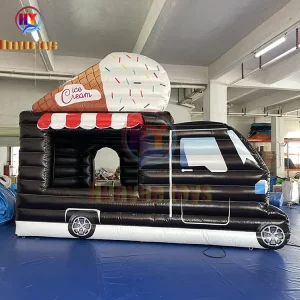
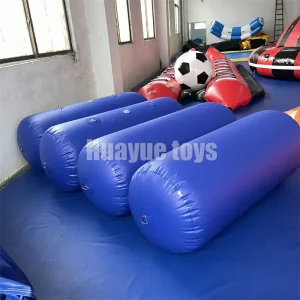
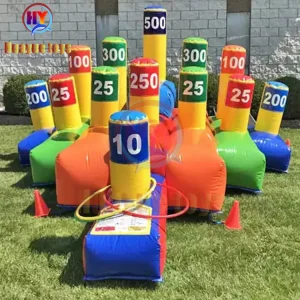
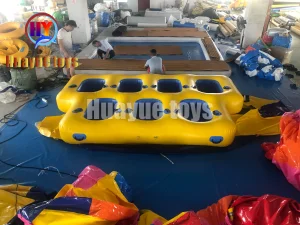
Precision-fabricated inflatable units engineered with heavy-duty commercial PVC tarpaulin, reinforced multi-point anchoring grids, and high-frequency automated thermo-welding lines.
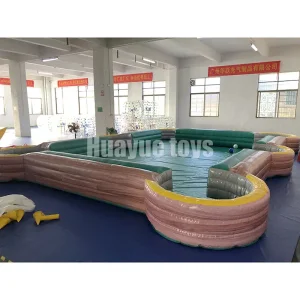
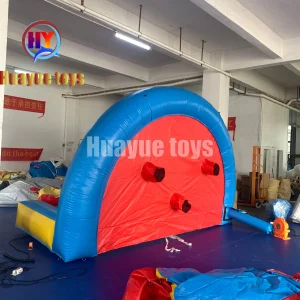

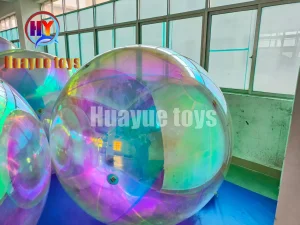
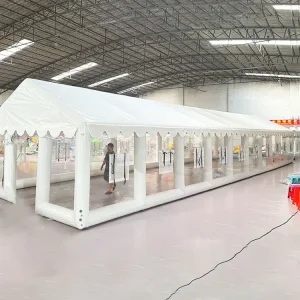
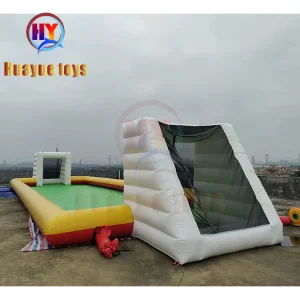
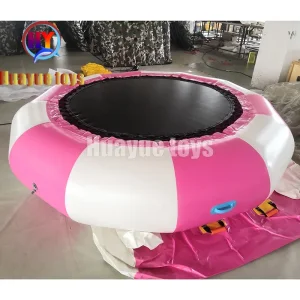
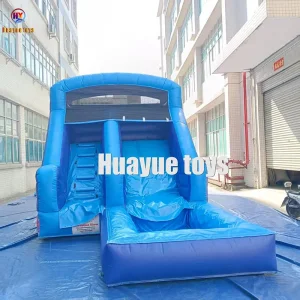
Across international commercial real estate developers, municipality carnivals, theme park operators, and high-turnover rental enterprises, the procurement criteria for a huge inflatable house have evolved from simple recreational novelties into complex civil-grade temporary architecture.
Global procurement teams demand high-density PVC composite fabrics with an internal 1000D to 1300D polyester interlock weave. The material must sustain minimum warp tensile strengths exceeding 2800 N/50mm and weft strengths above 2500 N/50mm under ISO 1421 testing standards, ensuring multi-chamber giant structures withstand repetitive dynamic live loads without delamination.
Mega-scale inflatable bounce houses, giant multi-tiered obstacle kingdoms, and monumental dome tents require calibrated continuous air replenishment. Procurement engineers calculate cubic feet per minute (CFM) capacity versus air displacement rates to optimize internal operating static pressures (1.5 kPa - 2.5 kPa) without over-stressing structural seams or generating parasitic energy consumption.
Operating a huge inflatable house in open-air environments requires structural compliance with EN 14960 wind threshold specifications (operating up to Beaufort Force 5, 38 km/h). Procurement protocols verify each tie-down anchor point is rated to withstand vertical extraction forces up to 1600 N to 2500 N, anchored with high-grade multi-layer stainless steel D-rings and seatbelt-grade webbing.
Direct factory supply models enable large-scale operators to eliminate middlemen markups while obtaining fully customized, site-optimized inflatable systems engineered for rapid deployment, high rider throughput, and long-term asset amortization.
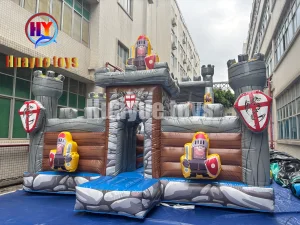
For high-traffic indoor theme parks and FEC franchises, high-throughput huge inflatable castles and modular obstacle ecosystems generate high revenue-per-square-meter. Modular connectivity allows operators to reconfigure the layout quarterly, refreshing visitor retention and maximizing long-term asset utilization.
Resort hospitality enterprises leverage modular floating water play castles, inflatable splash domes, and yacht-side launch parks. Fabricated using high-grade 0.90mm marine anti-fungal PVC tarpaulin with intense UV-shielding, these units endure hyper-saline maritime environments without chalking or seam failure.
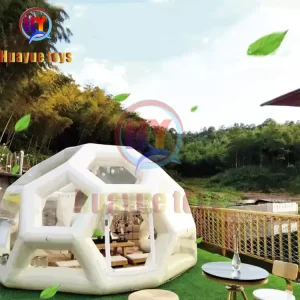
Commercial panoramic bubble domes and giant inflatable modular lodges bridge architectural luxury with eco-conscious reversibility. Zero ground-foundation excavation requirements allow operators to establish high-margin destination suites in pristine national park fringes and eco-sanctuaries within days.
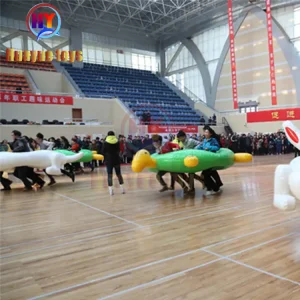
Global consumer brands demand bespoke giant inflatable houses, giant branded soccer arenas, and sculpted architectural pavilions for international product launches. Modular air-inflated structures collapse into compact transport crates, drastically trimming international air cargo and road freight overhead.
A granular breakdown of commercial membrane materials utilized in our manufacturing facilities versus common consumer-grade alternatives found across general market channels.
| Engineering Parameter | Industrial High-Duty PVC (Our Standard) | Mid-Tier Commercial PVC | Consumer Oxford Nylon (Low Grade) |
|---|---|---|---|
| Base Fabric & Weave Density | 1000D×1300D High-Tenacity Polyester 30×30/inch | 840D×840D Standard Polyester 20×20/inch | 420D / 210D Lightweight Oxford Cloth |
| Total Membrane Thickness | 0.55mm (Bounce floors) to 0.90mm (Structural tubes) | 0.40mm - 0.45mm Uniform | 0.15mm - 0.20mm Coated Polyester |
| Tear Strength (DIN 53363) | 350 N Warp / 320 N Weft (High Elastic Retention) | 180 N Warp / 160 N Weft | 45 N Warp / 40 N Weft (High Risk of Rip) |
| Thermal Bonding Technology | High-Frequency RF & Automated Hot-Air Fusion | Single-Chamber Manual Hot-Wedge | Simple Needle Stitched (Prone to Needle Hole Tearing) |
| Fire Retardancy Standard | ✓ NFPA 701, EN 13501-1 Class B-s1,d0 | Meets basic EN 71 Part 2 only | No Flame Retardancy (Severe Fire Hazard) |
| UV & Environmental Resilience | Anti-UV (UV50+ / 1000hr Xenon Arc), Anti-Microbial | Basic Topical UV Coating (Fades in 12 mo) | Rapid UV photodegradation within 90 days |
| Designed Commercial Lifespan | 5 - 8 Years Commercial Duty | 2 - 3 Years Light Rental | < 6 Months Seasonal Consumer |
Our manufacturing infrastructure integrates automated robotic pattern cutters, computerized tension simulation modeling, and digital pressure-retention diagnostics to spearhead the evolution of structural inflatables.
Every custom huge inflatable structure begins in 3D finite element simulation software. We mathematically calculate seam shear stresses, internal air-pressure dispersion, and guest impact dynamics, optimizing baffle panel geometry to eliminate localized failure zones before raw materials are cut.
Eliminating manual measurement tolerances, large-format CNC multi-ply cutting tables process high-tenacity PVC sheets with sub-millimeter precision (±0.2mm). Perfect bevels and interlocking seam margins ensure consistent structural symmetry across large 20-meter to 50-meter modular configurations.
Seams subject to severe hydrodynamic or pneumatic pressures are processed through European-imported high-frequency welding machines. By molecularly realigning the PVC polymer matrix under controlled dielectric pressure, the seam boundary achieves molecular unity that exceeds the tensile strength of the parent fabric.
Prototypes and production units undergo 72-hour continuous pressure-decay monitoring. We are pioneering IoT pressure-transducer telemetry for mega-structures, allowing operators to monitor live internal pressure, air consumption, and wind-loading metrics via mobile telemetry systems.
Operating commercial huge inflatable houses across top-tier international economies requires strict alignment with region-specific public safety, fire hazard, and structural amusement apparatus regulations.
In the United States and Canada, commercial huge inflatable houses must adhere to ASTM F2374 standards governing emergency egress slope angles, containment wall heights, and impact deceleration cushioning. All membrane layers satisfy NFPA 701 large-scale test flammability certificates and California Proposition 65 lead-free / phthalate-free toxicology mandates.
Deployments within Europe demand exhaustive certification according to EN 14960-1 (Inflatable play equipment). Our technical dossiers provide third-party validated calculations on entrapment hazard avoidance (head, neck, finger, and clothing apertures), minimum air pressure thresholds under max crowd capacity, and wind stability calculations up to 38 km/h.
Deploying inflatables across Australia and the Arabian Gulf presents unique engineering challenges. Our export products comply with Australia's AS 3533 structural requirements, while Middle Eastern shipments utilize specialized heat-deflecting titanium-dioxide PVC coatings resistant to thermal degradation in environments reaching ambient temperatures of 52°C.
Detailed technical answers to common queries submitted by global procurement directors, civil amusement engineers, and commercial fleet managers.
Explore our full spectrum of specialized commercial inflatables, from marine-grade yacht fenders and towables to high-impact branded pavilions and interactive sports arenas.