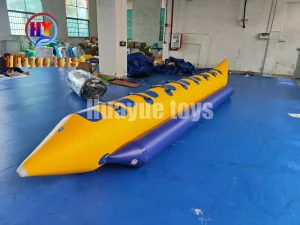
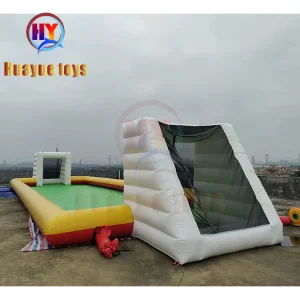
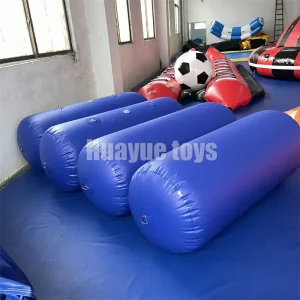
Precision-fabricated utilizing high-frequency thermo-welding lines, UV-shielded virgin PVC polymers, and reinforced marine anchorage points for extreme aquatic environments.
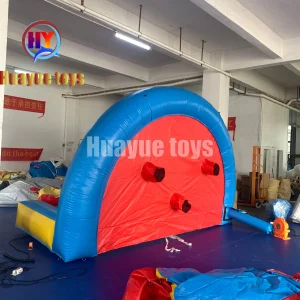
Evaluating commercial floating infrastructure, luxury maritime recreation, and resort capital expenditure trends across prime aquatic economies.
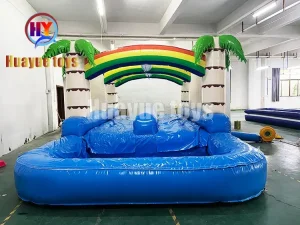
Global coastal resorts, inland lakes, and private waterparks are increasingly substituting fixed concrete marine structures with modular, low-impact giant inflatables for water. By cutting permitting lead times from several years to mere weeks, operators achieve dramatic operational agility. Inflatable water parks generate internal rates of return (IRR) exceeding 65% in their primary operating seasons due to scalable capacities ranging from 40 to 300+ simultaneous bathers.
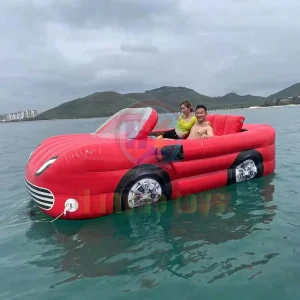
The global superyacht fleet (vessels 40m+) has seen unprecedented demand for tailored mega-inflatable toys, including custom curved transom yacht slides, anti-jellyfish sea pools, and extended tender docking platforms. Engineered with precision drop-stitch double-wall fabric and high-pressure hermetic valving, these marine appendages withstand offshore hydrodynamic swell while stowage volume remains under 1.5% of tender garage displacement.
Modern commercial operators navigate strict liability governance governed by European Standard EN ISO 25649 (Floating leisure articles for use on and in water), ISO 20957, and ASTM F2374. Compliance dictates tear-strength minimums exceeding 3,000 N / 50 mm, dual-chamber redundant compartmentalization, and entrapment-proof gaps under 8 mm to safeguard riders against hydraulic vortexes and entrapment risks.
Delivering industrial longevity against ultraviolet radiation, salinity degradation, chemical chlorination, and hydrostatic shearing forces.
| Performance Parameter | Commercial Marine Grade (Huayue Standard) | Conventional Commercial Grade | Low-Cost Consumer Grade |
|---|---|---|---|
| Base Polymer Composition | 0.9mm / 1100 Denier Virgin PVC Tarpaulin with High-Tenacity Polyester Mesh | 0.55mm – 0.65mm Recycled Composite PVC | 0.30mm – 0.40mm Unsupported Vinyl Film |
| Seam Bonding Technology | Hot-Air Thermo Welding (450°C - 500°C) + Dual Structural Seam Reinforcement Tapes | Cold Chemical Solvent Glueing (Adhesive-bonded) | Single-Pass Dielectric Frequency Welding |
| Tensile Strength (Warp / Weft) | 3200 N / 2850 N per 50mm strip (ISO 1421 / DIN 53354) | 1800 N / 1500 N per 50mm strip | < 750 N per 50mm strip |
| Hydrostatic Air Retention | Hermetic Pressure Seal: ≤ 2.5% loss over 48h static test period | Requires continuous topping-off daily | Continual Blower Dependent |
| Marine Environmental Resistance | Anti-UV (UV Index 8+ Rating), Saltwater Anti-Microbial Fungicide Coating | Moderate UV protection, prone to yellowing & embrittlement | Zero saline barrier; rapid photochemical cracking |
| Anchorage Load Capacity | 316 Marine Stainless Steel D-Rings, 4-Layer Reinforced Welded Plates (>1,200 kg pull test) | Galvanized Steel D-Rings, 2-layer welded plate (<450 kg pull test) | Stitched nylon web loops (<100 kg pull test) |
Engineered solutions customized to distinct nautical, meteorological, and economic operational realities.
Coastal applications demand structural dampening against continuous maritime tides, swell surges, and cyclonic wind shear. Our open-water layouts incorporate flexible elastic bungee tethering connected to heavy concrete helical moorings. Underwater ballast chambers integrated underneath floating platforms ensure high stability, preventing overturning even under dynamic human loads during high-tide conditions.
Yacht installations focus on swift deployment, zero paintwork friction, and high-prestige aesthetic harmonization. Custom yacht slides are measured using 3D laser scanning of the yacht's transom or upper sun-deck railing. Outfitted with soft-touch lifting points, specialized non-chafing neoprene hull bumpers, and rapid evacuation deflation valves, deckhands can deflate and pack a 12-meter yacht slide in under 20 minutes.
Lakes and inland freshwater reservoirs possess static water lines but face intensive peak-hour foot-traffic. We engineer continuous interlocking circuit courses incorporating high-velocity slides, bounce domes, and balance beams. Integrated perimeter safety nets prevent non-swimmers from falling into restricted mooring zones, maintaining pristine lifeguard visibility.
Leading the technological transition from static buoyant bladders to smart, sensor-driven aquatic attractions.
Thermal expansion on hot midday water surfaces can cause internal pressures to spike from 1.5 PSI to dangerous thresholds exceeding 3.5 PSI. Our next-generation smart valves feature autonomous pressure sensors with self-bleeding solenoids and automated solar-powered re-inflation actuators, maintaining optimal structural stiffness without manual labor.
In accordance with international marine conservation treaties and microplastic mitigation guidelines, our R&D center is accelerating the deployment of 100% recyclable, plasticizer-free aromatic and aliphatic TPU laminates. These polymers yield 30% lower overall tare weight, quadruple puncture abrasion tolerance, and eliminate chemical phthalate leaching in delicate coral reef environments.
Implementing computational fluid dynamics (CFD) and finite element analysis (FEA) into our 3D pre-production approval protocol. Every giant inflatable water installation is computationally subjected to local wave-height spectra, current vectors, and rider collision simulations to optimize anchor line angles and seam stress concentrations prior to raw material cutting.
End-to-end industrial lifecycle support delivering sustainable asset management and operational profitability.
Professional assessment of shoreline morphology, water depth variances, seabed substrate (sand, silt, or reef rock), and statutory marine park constraints. Our engineering teams calculate minimum safe fall heights (water depth ≥ 2.5m for slides > 3m height) to guarantee strict user safety.
Custom-engineered anchoring configurations utilizing deadweight concrete blocks, screw augers, or sea-floor helix anchors. We specify marine synthetic shock cords and low-stretch Dyneema lines to absorb surging kinetic wave impacts without transferring destructive forces to inflatable eyelets.
Complete documentation packages encompassing risk assessment protocols, EN 14960 daily operational checklist templates, localized operator staff certifications, bio-fouling cleaning protocols, and heavy-duty cold/hot patch field repair methods.
In-depth technical answers regarding fabrication, certification, power delivery, anchoring, and warranty protocols.
Engineered for commercial rental fleets, tactical sports tournaments, and waterfront experiential branding campaigns.