A Sports Arena Bounce House is an inflatable play structure designed to evoke the energy of an indoor sports venue. It may feature bold team-style colors, court-inspired graphics, or play elements such as basketball hoops and climbing areas. The exact design varies by model, so the name alone does not tell you what activities it includes. That matters. A buyer should check the product description, dimensions, age guidance, and setup requirements before choosing one.
This introduction explains what the term usually means and how these inflatables differ from simpler bounce houses. It also considers where one might fit, from a family celebration to a supervised community event. In practice, the usable space around the inflatable matters as much as its printed size. Allow room for entry, exit, and adult supervision, and follow the manufacturer’s instructions for anchoring and capacity. Details matter. The label can be a little imprecise: two products with the same arena theme may offer very different layouts and features. A colorful design can look impressive, but appearance alone says little about construction or suitability. Careful comparison is more useful than relying on photos. By understanding the theme, basic features, and practical checks, readers can make a more informed choice and set realistic expectations for play.
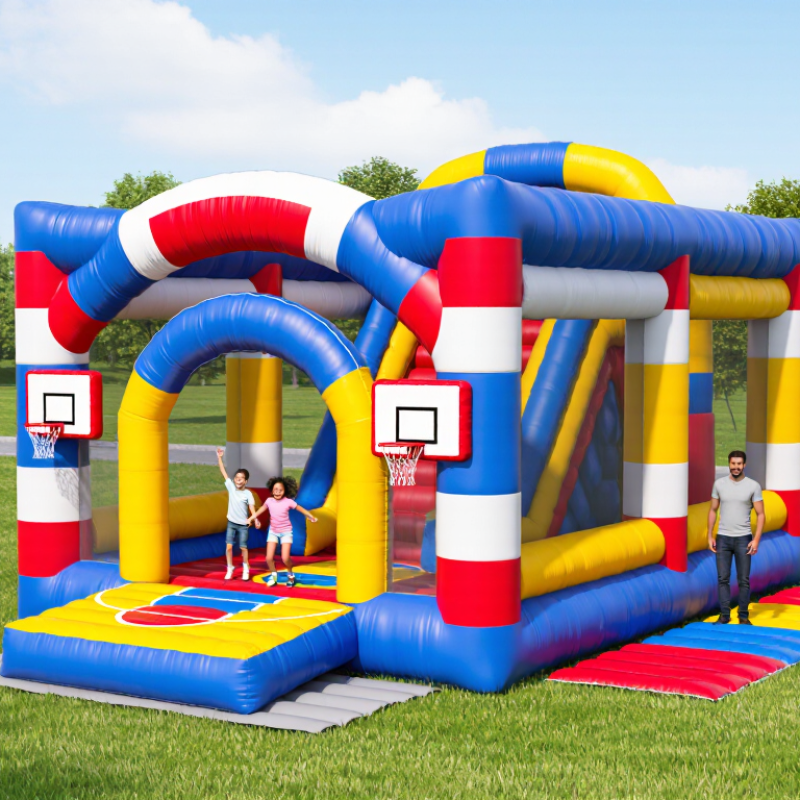
A sports arena bounce house is an inflatable play space designed for bouncing and simple sports-style games. Its enclosed layout may include goals, hoops, soft obstacles, or marked play zones. Unlike a basic bounce house, it gives children room to move between play features. Exact layouts vary, so the name does not describe one fixed design.
The inflatable walls help define the play area, while a cushioned floor supports jumping and running. Some models include basketball-style hoops or targets for tossing lightweight balls. Others offer small soccer goals or obstacle sections. These features can make play feel more organized, though a busy layout may leave less room to bounce.
That matters.
Key practical features include a clear entrance, visible seams, and secure anchoring points. Operators should check the inflatable for damage, confirm that it is firmly secured, and follow its capacity and age guidance. Adult supervision is important, especially when children differ in size or play style. Airflow and clear exits also deserve attention.
A sports theme alone does not guarantee a suitable setup; the available space, surface, and equipment condition all affect how the arena can be used. The term can sound precise, but designs differ. It is worth checking the actual play features before choosing one.
What Is a Sports Arena Bounce House?
How Inflatable Arenas Blend Bouncing With Sports Challenges
A sports arena bounce house combines a cushioned play area with simple athletic games. Instead of bouncing without a goal, visitors might aim soft balls at targets, weave around inflated obstacles, or race through a short course. Clear lanes help keep each activity easy to understand. Keep it moving.
Some arenas use separate zones for different challenges. One corner may host a target toss, while another offers a timed relay or a low, padded obstacle route. Bright boundary markings and visible scoring panels can help players follow the rules. A staff member nearby can explain turns, watch for collisions, and pause play when an area gets crowded.
The bounce adds unpredictability: a ball may skip away, and a careful step can turn into a wobble. That is part of the fun, though it can make precise scoring harder than expected. Organizers should match games to the space, player ages, and number of participants. They should also check the inflatable for damage, use it on a suitable surface, and follow its capacity and supervision guidance. Not every challenge needs a winner. Sometimes the best moment is a missed shot followed by an honest laugh.
Ball Sizes Used in Sports Challenges
Inflatable arenas can pair bouncing with familiar sports challenges, such as kicking, passing, or shooting. The chart compares standard circumference ranges for a FIFA Size 5 soccer ball, an FIVB indoor volleyball, and a FIBA Size 7 basketball. Values are converted to inches and rounded; bounce-house games may use different ball sizes.
A sports arena bounce house turns part of a court into an inflatable play zone. Its bright walls can make it feel simple. The safety work is less simple. ASTM F2374 sets practices for the design, manufacture, operation, and maintenance of inflatable amusement devices. EN 14960-1 specifies safety requirements and test methods for inflatable play equipment. They are separate frameworks, not interchangeable labels or guarantees of safe operation.
Both point operators toward practical checks: secure anchoring, stable air pressure, suitable clearance, and controlled entry. Staff should inspect seams, blowers, anchor points, and the landing surface before opening. They should also follow the unit’s capacity limits and stop use when wind or other conditions exceed operating guidance. Details matter. A slightly loose anchor or crowded entrance can change how the equipment behaves.
In a Pediatrics study using U.S. emergency-department data, researchers estimated 64,657 inflatable-bouncer injuries among children from 1990 to 2010; the annual injury rate rose about fifteenfold over that period. This older estimate is not a current arena-specific risk rate, but it shows why routine supervision matters. Standards support safer practice; they cannot replace attentive staff or a careful setup. And checklists can be rushed. That deserves reflection.
A sports arena bounce house is a large inflatable play area designed for active group use. Its safe capacity depends on more than its outside dimensions. Check the manufacturer’s stated user limit, age or height guidance, and setup instructions. Ratings can differ between models. Do not assume a larger-looking unit always holds more participants.
Measure the full setup area, not just the inflatable’s footprint. Leave the clearance specified by the manufacturer around the unit, and account for entrances, exits, blower placement, and waiting lines. Indoors, check ceiling height and nearby lights or scoreboards. Outdoors, confirm the ground is suitable for setup and anchoring. Keep walkways and emergency access clear. A tape measure beats a guess.
On setup day, compare the actual site with your measurements. If the space feels tight, choose a smaller unit or limit attendance rather than improvising. Follow the setup guide for power, anchoring, and operating conditions. Staff should monitor the number of users and pause activity when conditions fall outside the instructions. Even careful planning can miss a detail, especially around queues; walk the area once more before opening.
What Is a Sports Arena Bounce House?
Active Play in Context: WHO’s 60-Minute Daily Activity Guideline for Ages 5–17
A sports arena bounce house offers a large inflatable space for jumping, balancing, and changing direction. For ages 5–17, it is one part of an active day, not a stand-alone health plan. WHO recommends an average of at least 60 minutes of moderate-to-vigorous activity daily across the week (WHO, 2020). Most activity should be aerobic. Vigorous and muscle- and bone-strengthening activity is recommended on at least three days each week. Small details matter: landing, pausing, and taking turns can affect how much children actually move.
The need is real. A pooled analysis covered 1.6 million students in 146 countries. It estimated that 81% of adolescents aged 11–17 did not meet activity recommendations (Guthold et al., The Lancet Child & Adolescent Health, 2019). This is a population estimate, not a verdict on any child. A bounce session can add energetic minutes, especially when play involves repeated movement rather than long waits. Still, it cannot guarantee a full 60 minutes, and activity levels vary.
Adults can watch for crowding and fatigue, allow recovery time, and encourage water breaks and age-appropriate play. The lively noise can disguise long pauses. I might overestimate how active a session feels. Tracking actual moving time alongside walking, cycling, sport, and outdoor play gives families a clearer picture. Use the inflatable as an inviting option, not the whole answer.
| Topic | Evidence-based context | Practical interpretation |
|---|---|---|
| What it is | A “sports arena bounce house” generally describes an inflatable play structure set up in an indoor or outdoor sports or event venue. The phrase is descriptive, not a specific WHO activity category. | Activities may include bouncing, jumping, and moving through the structure. The amount and intensity of movement depend on the child and the activity. |
| WHO guideline for ages 5–17 | The World Health Organization recommends an average of at least 60 minutes per day of moderate-to-vigorous, mostly aerobic physical activity across the week. | This is a daily average across the week—not a requirement that all activity happen in one session or at one venue. |
| Higher-intensity and strengthening activity | WHO recommends that vigorous-intensity aerobic activities, as well as activities that strengthen muscles and bones, be included at least 3 days per week for this age group. | A bounce-house session should not automatically be counted as meeting every part of this recommendation; activity intensity and the type of movement matter. |
| When active play may count | Time spent in play may contribute to the daily total when it involves moderate-to-vigorous physical activity. A venue or piece of equipment alone does not determine the activity’s intensity. | Consider the child’s actual movement and effort. Quiet waiting or resting time is not moderate-to-vigorous activity. |
| A varied weekly routine | The WHO recommendation focuses on regular activity across the week, including mostly aerobic activity and, on at least 3 days, vigorous and muscle- and bone-strengthening activity. | Active play can be one option alongside activities such as walking, running, cycling, dancing, sports, and age-appropriate strength or jumping games. |
| Safety during inflatable play | Inflatable play has activity-related risks, including falls and collisions. Safe use depends on factors such as appropriate supervision, following the operator’s rules, and using equipment as instructed. | Check posted age, size, and capacity limits; remove footwear and sharp objects if instructed; and stop play if the structure or conditions appear unsafe. |
| Key takeaway | Bounce-house play can be an enjoyable form of active play, but it is not a guaranteed substitute for the full WHO activity recommendations. | Count only the time involving relevant activity, and support a varied, regular routine that meets the child’s needs and abilities. |
Guideline reference: World Health Organization, WHO Guidelines on Physical Activity and Sedentary Behaviour (2020). This table provides general information and is not a medical assessment.
It is an enclosed inflatable play space for bouncing and simple sports-style games. Designs vary.
Some have small goals, hoops, soft obstacles, or marked play zones. Not every model has all four.
It may give children several play features to move between. A crowded layout can leave less room for bouncing.
Follow the manufacturer’s capacity and age or height guidance. A larger-looking unit does not always hold more children.
Measure the inflatable and its required clearance. Include entrances, exits, blower space, and waiting lines. A tape measure helps.
Check ceiling height and nearby lights or scoreboards. Those details are easy to overlook.
Look for damage, visible seams, secure anchoring, airflow, and clear exits. Walk the area again; queues can shift.
Choose a smaller unit or limit attendance. Do not improvise around the setup instructions. I might still miss a detail.
A Sports Arena Bounce House is an inflatable play space that combines the energetic fun of bouncing with sports-inspired activities. Its layout may include open jumping areas alongside challenges such as throwing, kicking, or navigating around obstacles. This blend encourages movement, coordination, and playful competition, making the arena suitable for organized activities as well as free play.
Safety and setup are central to a successful experience. Standards such as ASTM F2374 and EN 14960 provide frameworks for inflatable design, operation, and safety practices. Before use, match the number of participants to the manufacturer’s capacity rating and make sure the venue has enough room for the inflatable and its safe operation. For children ages 5–17, active play can also contribute toward the World Health Organization’s guideline of at least 60 minutes of daily physical activity.